
Custom AI Dataset Creation Services
Build a custom AI dataset around your model task, coverage gaps, technical format, metadata, annotation, licensing and acceptance criteria.
Wavebreak Media can curate owned content, produce new image, video, text, document or template data, work with authorized buyer material, or combine these sources.
Featured Datasets
Explore sample licensed datasets across image, video, audio, and text collections.


Custom AI Data Collection and Sourcing Options
Choose one sourcing route or combine them under one dataset specification.
Archive-Curated Datasets
Select owned assets from the Wavebreak Media Dataset Library by subject, activity, environment, format, metadata and available release coverage.
Purpose-Built Data Production
Create missing coverage through controlled image or video production, editable design work, or human-authored text and documents.
Hybrid Dataset Creation
Start with eligible archive content, then produce missing classes, actions, viewpoints, environments, languages, layouts or edge cases.
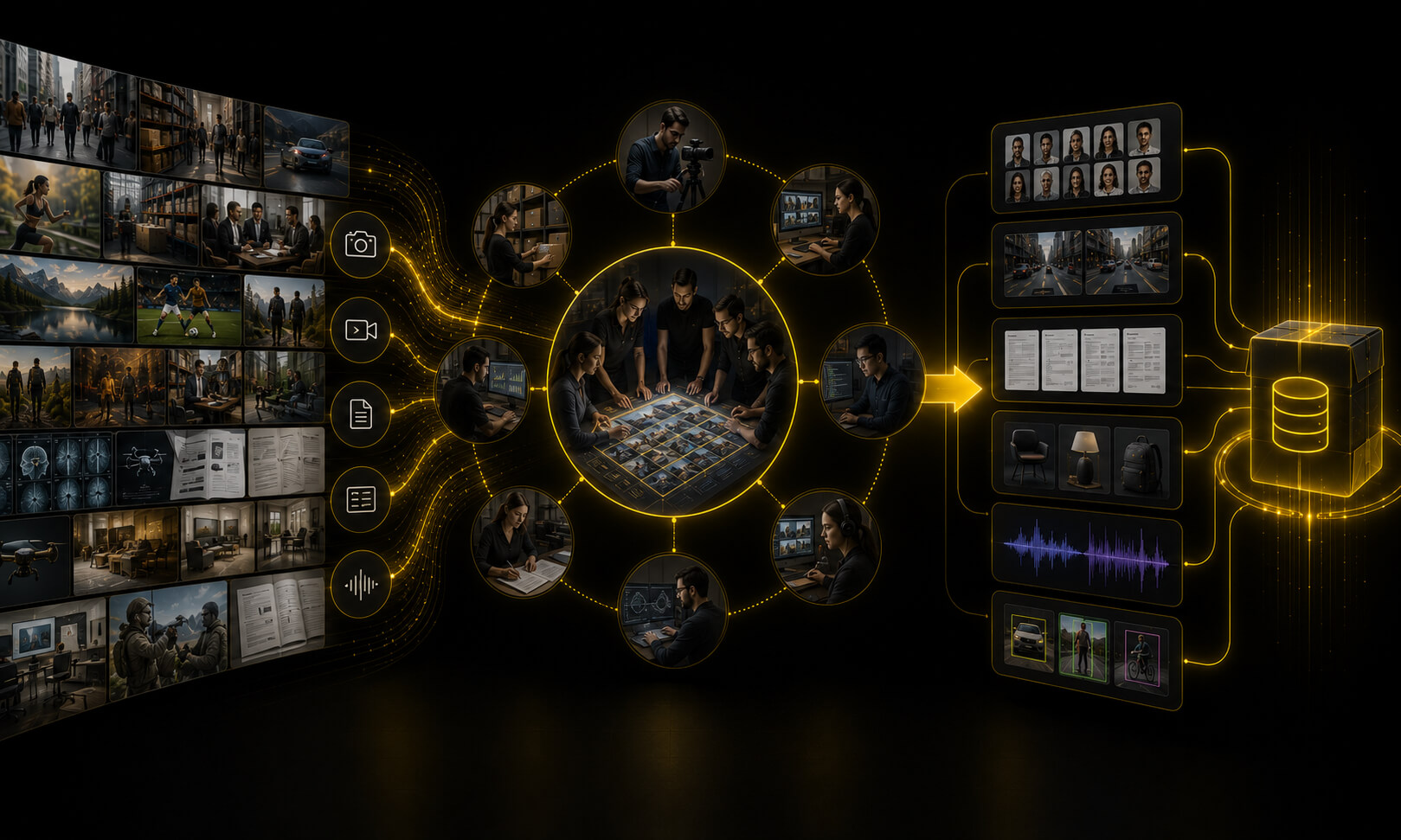
Custom Dataset Types
Custom Image Datasets
Curate or produce custom image datasets by subject, environment, viewpoint, capture conditions, metadata and release coverage.
Custom Video Datasets
Curate or record video datasets for AI training around defined actions, sequences, camera setups, environments, audio and temporal coverage.
Custom Text Datasets
Create human-authored text datasets with instructions, dialogues, summaries, classifications, retrieval examples or evaluation items.
Custom Document Datasets
Create document datasets for AI training from new material or authorized buyer content for OCR, extraction, classification, RAG and Document AI.
Custom Template Datasets
Curate or create editable template datasets with source files, layers, components, previews and structured production metadata.
Custom Multimodal Datasets
Create synchronized multimodal AI datasets for video-audio-text workflows or aligned vision-language datasets for captioning, grounding, retrieval and visual question answering.
Define the Custom Dataset Specification
A written specification defines project scope, production requirements and acceptance criteria.
- Model task and use: Training, fine-tuning, evaluation, benchmarking, enrichment or coverage expansion.
- Content coverage: Subjects, classes, participants, actions, environments, languages, variation, quotas, exclusions and edge cases.
- Technical format: Modalities, volume, resolution, duration, aspect ratio, codecs, source formats and file structure.
- Metadata and annotations: Taxonomies, IDs, labels, captions, fields, spatial or temporal annotations and JSON, JSONL, CSV or a custom schema.
- Quality and splits: Acceptance thresholds, review rules, class balance, deduplication, leakage controls, train-validation-test splits, manifests and versions.
- Rights: Permitted AI uses, provenance, release coverage, documentation and restrictions affecting source selection or production.
Custom Dataset Creation Process
Review the Brief
Confirm feasibility, identify missing requirements and define scope constraints.
Choose Sources and Pilot
Choose archive content, new production, authorized buyer data or a hybrid route. Validate a pilot when needed.
Curate or Produce
Create the approved content and track progress against coverage targets.
Annotate and Validate
Apply the schema, run quality checks, resolve exceptions and verify acceptance criteria.
License and Deliver
Confirm permitted uses, then transfer accepted files, manifests and documentation through the agreed secure dataset delivery method.
Owned Source Content and Production Capacity
Wavebreak Media owns and originally produced the visual content in its archive of more than 4 million assets. Reviewing this content can reduce new production needs and expose coverage gaps early.
Our established network of photographers, videographers and production crews can create missing coverage around defined performers, objects, actions, viewpoints, camera setups and environments.
Available provenance, applicable releases, permitted uses and dataset licensing and compliance requirements are reviewed for the selected data and project scope.
Frequently Asked Questions (FAQ)
Yes, when the buyer is authorized to provide and use the material. Source files, examples, exclusion lists, taxonomies and existing annotations can be assessed alongside Wavebreak Media data. The project agreement defines permitted handling.
Potential exclusivity depends on the source and commercial agreement. Project terms must distinguish new production, archive content, annotations, derivative assets, permitted AI uses and Wavebreak Media reuse rights.
Pricing depends on the sourcing route, volume, production or authoring effort, annotation and QA complexity, licensing and exclusivity. The approved brief provides the basis for the quote.
Timing depends on feasibility, participant or location access, production windows, pilot feedback, buyer approvals and correction cycles. The schedule is confirmed after these dependencies are known.
Yes, when the specification, taxonomy, identifiers and versioning rules support expansion. Additional classes, scenarios, formats, annotations or evaluation slices are documented as a new version.
No. Wavebreak Media delivers data against agreed acceptance criteria. Model performance also depends on architecture, training methods, other data, evaluation design and deployment conditions.
Request a Custom AI Dataset
Send your dataset brief or core requirements. Wavebreak Media will assess feasibility, identify missing inputs and prepare a project scope.
