
Vision-Language Model Datasets for AI Training
Build vision-language datasets from Wavebreak Media's owned image and video archive, or commission new visual capture. We produce the source media and can prepare captions, question-answer pairs and grounded annotations for your VLM task.
Featured Datasets
Explore sample licensed datasets across image, video, audio, and text collections.


Vision-Language Datasets by Task
Choose the visual-language relationship your model must learn, from image-text matching to temporal or region-level grounding.
Image-Text Pretraining and Retrieval
Image-text pairs built from captions, descriptions, tags or concepts, with positive and negative matches and relevance labels for training or retrieval.
Image Captioning
Short captions, dense descriptions or multiple references per image, following agreed detail and style rules without adding unsupported visual claims.
Video Captioning
Clip- or segment-level descriptions of actions, events and scene changes, preserving temporal order through timestamps or frame references where required.
Visual Question Answering
Image- or video-grounded questions and answers about objects, actions, counts, spatial relationships, visible text, scenes and events over time.
Visual Grounding
Referring expressions linked to an object, region, frame or moment through commissioned boxes, masks, timestamps or other agreed visual references.
Visual Instruction Tuning
Single- or multi-turn visual prompts and responses for supervised fine-tuning, with separate test examples for model evaluation and benchmarking.
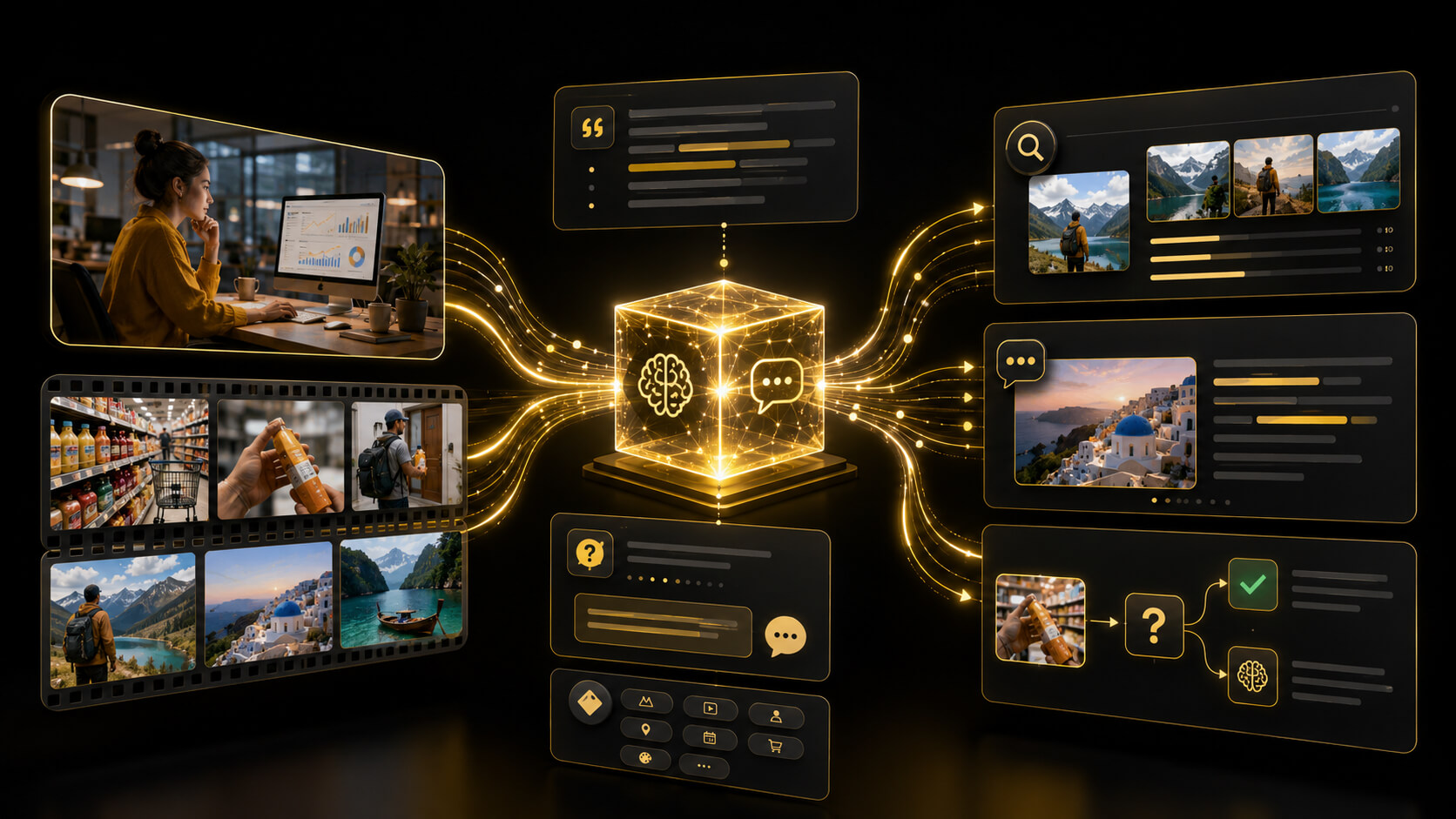
Visual Content for VLM Data
Coverage is assessed against the subjects, pair volume and annotation scope in your brief.
Candid Family and Lifestyle Images covers family, friendship, conversation, household and leisure scenes that can be paired with captions, questions or retrieval text.
People and Social Interaction
Portraits, communication, teamwork and group scenes. People and Human Interaction Images provides source material for pairing with language annotations.
Human Activity and Object Use
Daily routines, exercise, mobility, device use and tool handling, including people interacting with products or equipment in everyday environments.
Products, Retail and Food
Consumer goods, packaged products, household objects, ingredients, meals and shopping activity, with items shown alone, in use or in context.
Workplaces and Technology
Professional environments, meetings, computer use, devices and collaboration, with task-based business scenes across participants and settings.
Travel and Outdoor Scenes
Transport, streets, landmarks, tourism, nature, weather and outdoor activities, with environmental context across urban and natural locations.
Animation and Creative Assets
Animation, motion graphics and designed compositions, subject to suitable source assets and the structural relationships required for annotation.
Pairing and Annotation Specification
Pair Structure
Stable visual, clip, frame and text IDs, including question and answer IDs. Define one-to-one or one-to-many links, pair types and source relationships for each record.
Language Fields
Captions, descriptions, questions, answers, choices, rationales, instructions and responses. Specify language, locale, required fields and authoring or review status.
Grounding and Alignment
Object or region references, referring expressions, boxes, masks, frame IDs, timestamps and temporal segments. Confirm the annotation scope and coordinate or timing conventions.
Quality and Acceptance
Groundedness, text consistency, pair relevance and hard-negative checks. Define prohibited inferences, review stages and acceptance thresholds before scaling annotation.
Owned Visual Sources and Custom Production
Wavebreak Media has produced professional visual media since 2005. Select image datasets or video datasets from our owned archive, then confirm the language annotation needed. Video pairing can preserve source sequences, segment boundaries and timing relationships.
Review visual samples before investing in annotation. Where archive coverage is insufficient, custom VLM dataset production can combine new capture with the agreed text and grounding work.
Dataset Packaging and Delivery
Agree media formats, schemas, manifests and split versions, with checksums where required. Preserve source-to-text relationships throughout packaging. See dataset delivery and security for transfer requirements.
Frequently Asked Questions (FAQ)
Not automatically. Titles, keywords and stock descriptions may need normalization, expansion or replacement. Review representative visual-text pairs against your task before commissioning the full dataset.
Yes, when scoped. Agree author qualifications and whether text is human-authored, machine-assisted or reviewed by humans. These are distinct production methods and should be documented for the selected data.
Feasibility depends on language, locale and qualified author and reviewer availability. Specify translation and original native-language annotation separately; they require different production and review workflows.
This page focuses on language paired with images or video. See multimodal AI datasets for broader combinations such as synchronized video and audio.
Group related source assets, shoots, sequences, extracted frames, near-duplicate visuals and derived text according to the evaluation protocol. Confirm which relationships can be verified and document remaining limits; grouping alone does not guarantee that every overlap is detected.
Available provenance and applicable releases can be reviewed for the selected visual and language data. The agreement defines permitted AI uses and restrictions. See dataset licensing and compliance.
Request a Vision-Language Model Dataset
Send your VLM task, visual subjects, pair volume, language and an example record. Include grounding or temporal requirements where relevant.
