
Licensed Video Datasets for AI Training
License ready-made video datasets, select footage from Wavebreak Media's owned archive, or commission new production for your AI model.
We produce the source footage. Specify the actions, sequence lengths, camera setups, formats and annotations your project needs.
Featured Datasets
Explore sample licensed datasets across image, video, audio, and text collections.


Video Data by Model Task
Video Classification and Understanding
Clips and ordered sequences for recognizing events, scene changes and motion over time.
Human Activity Recognition
Human activity recognition datasets covering gestures, multi-step tasks and interactions between people and objects.
Object Interaction and Tracking
Footage of objects being handled, moved or transformed. Boxes, tracks and interaction labels can be scoped separately.
Camera Motion and Multiple Views
Camera-motion annotations and synchronized multi-view video for studying camera movement and comparing perspectives.
Video-Text and Audio-Visual Learning
Explore vision-language datasets for captioning and video question answering, or multimodal datasets for synchronized video, sound and transcripts.
Video Generation and Evaluation
Source footage for generative video training or select held-out collections for model evaluation.
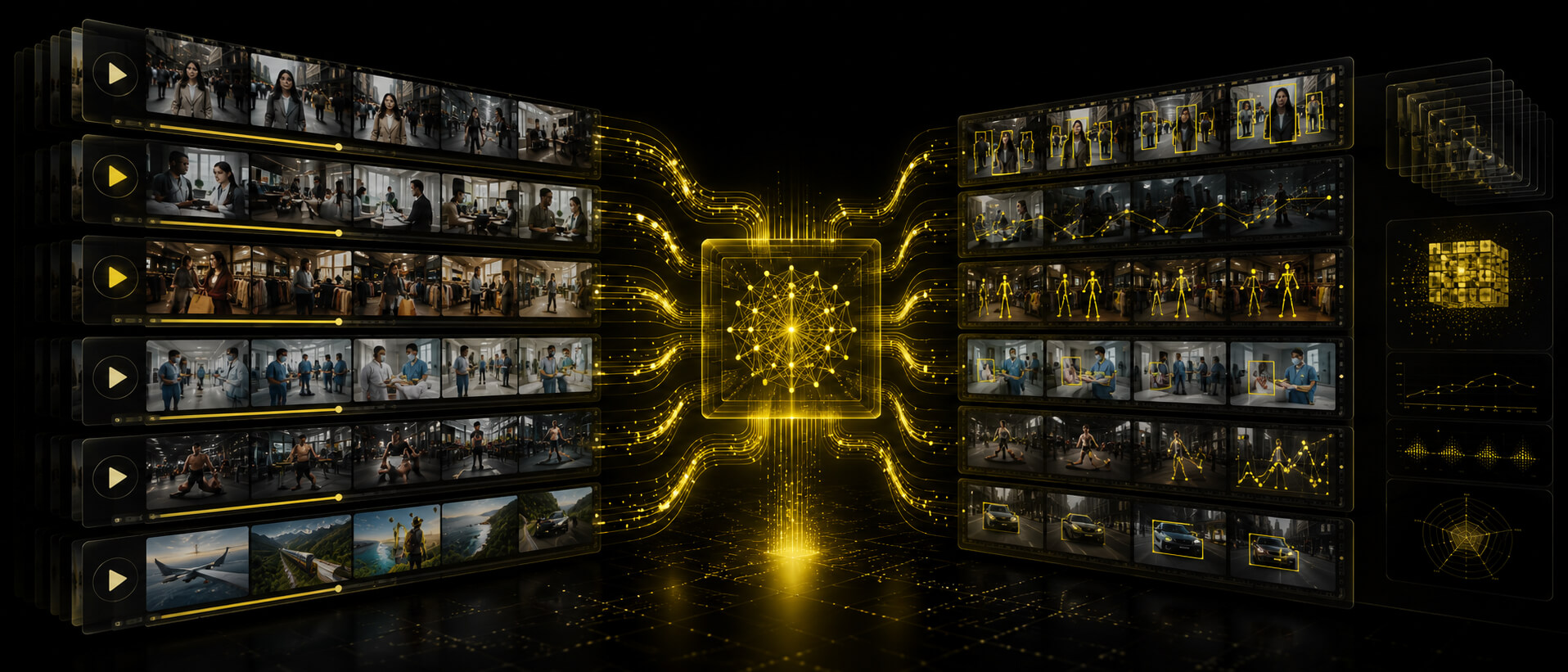
Video Collections and Capture Formats
Review these collections against your content, duration, format and release requirements. Availability and included annotations are confirmed per dataset.
Human Motion and Complete Tasks
Human Motion DV01 for actions and gestures; long-form procedural video for complete, multi-step activities.
Sports and Fitness
Sports DV06 and the Sports Video Dataset cover athletic movement, exercise and training sequences.
Everyday Activities
Footage of cooking, product use, device handling, household routines, workplace activity, healthcare and retail settings.
Urban Life and Mobility
Urban City Life and Mobility Video covers walking, commuting, navigation and social interaction in public environments.
Native RAW Video
Blackmagic RAW, RED R3D and DJI Ronin ProRes RAW collections with available camera metadata.
RAW-to-Output Pairings
RAW-to-edited video pairings connect source footage with corresponding outputs. Review the paired transformations and alignment before selecting the collection.
Specify the Footage Your Model Needs
Use these criteria to select existing footage or define new capture requirements.
- Sequence length: Short clips, uninterrupted takes, complete procedures and action transitions.
- Movement: Speed, repetition, pauses, action order and variation between performances.
- Continuity: Consistent subjects, object-state changes and progression through a task.
- Camera setup: Viewpoint, framing, orientation, movement, stabilization and synchronized views.
- Capture format: Resolution, frame rate, codec, bitrate, RAW and slow-motion availability.
- Scene coverage: Lighting, backgrounds, occlusion, clutter, clothing and indoor or outdoor settings.
Video Annotations, Metadata and Dataset Splits
Metadata varies by collection. Additional annotations, grouping rules and validation checks are scoped before preparation.
- File relationships: Asset and sequence IDs, grouping, source links and manifests.
- Annotations: Clip labels, timestamps, action segments, scene boundaries, boxes, tracks or keypoints where commissioned.
- Metadata: Captions, subjects, scenes, duration, resolution, frame rate, codec and available camera fields.
- Dataset splits: Agree grouping by shoot, participant, location or sequence, near-duplicate rules and validation checks to reduce overlap between training and test sets.
Confirm permitted uses and available provenance and release documentation for the selected footage. Packaging, checksums where required and secure transfer are agreed for each delivery.
Ready-Made, Curated or Custom Video Data
License a Collection
Compare samples, volume, formats and included metadata in the Dataset Library.
Select Archive Footage
Request a subset of Wavebreak Media-owned footage filtered by actions, scenes, duration, capture format and release coverage.
Commission New Capture
Use custom video dataset production for missing actions, viewpoints, repetitions or complete sequences.
Frequently Asked Questions (FAQ)
Use video when motion, action order, duration or continuity matters. Use image datasets for AI training when individual frames contain the information needed.
Not necessarily. Edited clips may omit the start, transitions or completion of a task. Review sequence coverage in the samples; long-form footage or new capture may be needed for complete procedures.
No. Included labels and metadata depend on the collection. Additional timestamps, action segments, boxes, tracks, keypoints or captions require an agreed scope, quality criteria and validation process.
Grouping can be scoped around shoots, participants, locations or sequences where source identifiers allow it. Agree near-duplicate checks and split rules before preparation; random clip-level splitting may leave related footage in both training and test sets.
Yes, under collection-specific terms. Confirm the intended model uses, restrictions and available provenance and release records before licensing. Ownership of footage alone does not specify every permitted use.
Where the source supports it, footage can be paired with audio, transcripts or captions. See audio-visual datasets for synchronized media and video-text datasets for language-aligned tasks.
Request Video Datasets for AI Training
Share the model task, footage requirements, target volume and required annotations. Wavebreak Media will check existing coverage and identify any need for new production.
