
Custom Document Datasets for AI Training
Commission new documents or turn your authorized source files into datasets for AI training, OCR, information extraction and retrieval.
Wavebreak Media creates each dataset to order, with document types, formats, annotations and volume defined for your project.
Documents for OCR, Extraction and Language Models
Create forms, invoices, reports, manuals and business records, or prepare an authorized enterprise collection for the task below.
OCR and Document AI
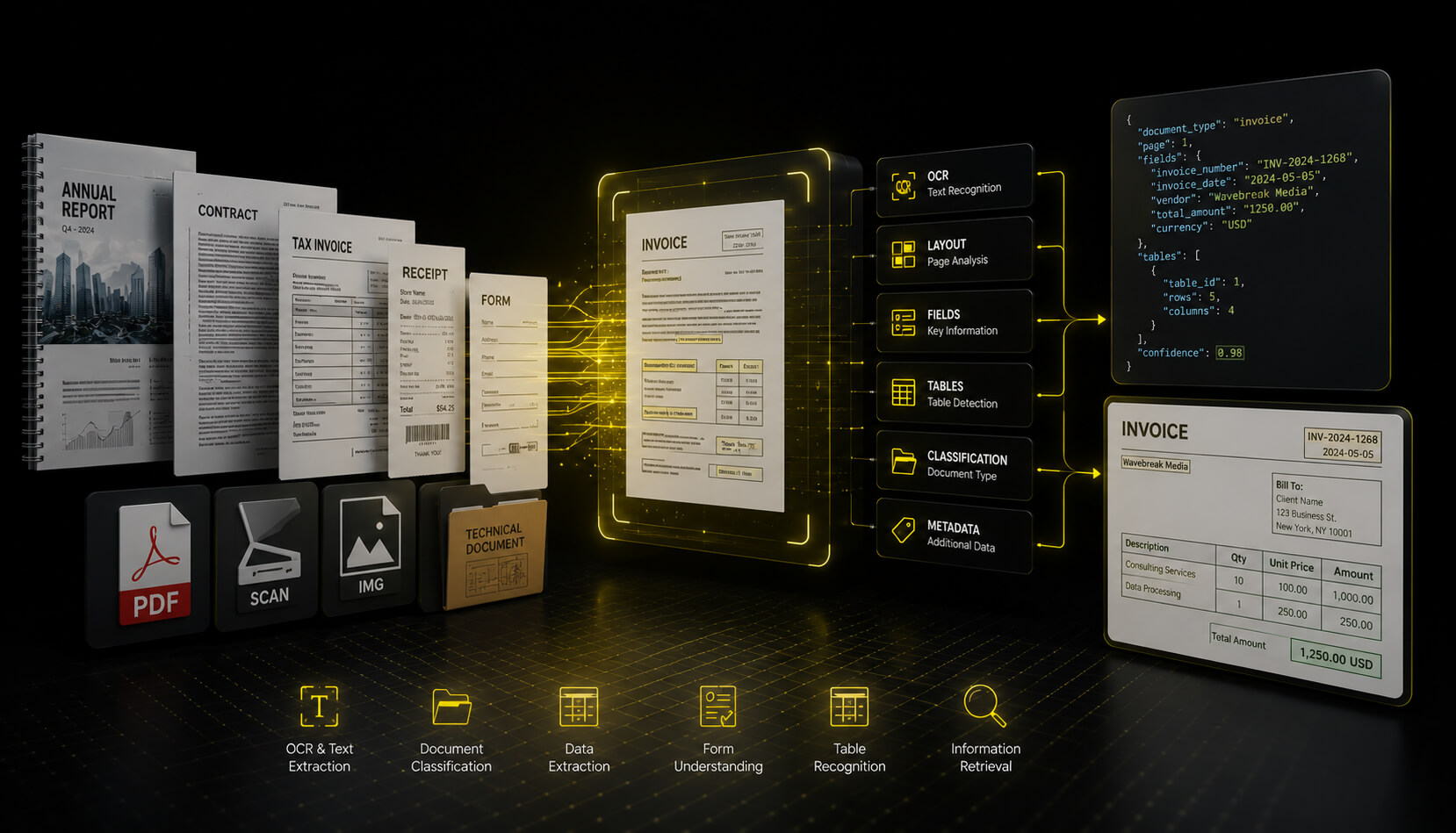
Pages with agreed reference text, reading order, layout regions, fields and table annotations for recognition, classification and extraction.
RAG and Document Search
Organized and segmented documents with source IDs and metadata for retrieval corpora used by knowledge assistants and search systems.
LLM Training and Evaluation
Document-based content for fine-tuning and summarization, with task-specific labels or reference answers where commissioned. See model evaluation datasets for dedicated test collections.
Define Your Document Dataset
Content and Layout
Domains, document classes, languages, terminology, page counts, headings, tables, forms and layout variation.
Sources and Authorship
Human-authored documents or authorized source files, writer requirements, approved references and rules for factual, fictional or sensitive content.
Volume and Coverage
Quotas by class, language, length, format and difficulty, with agreed training, validation and test grouping.
Metadata and Annotations
Document IDs, taxonomy labels, segments, entities, key-value pairs, tables, OCR text, reading order and layout regions, as required.
File Formats
DOC, DOCX, PDF, HTML, Markdown, TXT or page images. Metadata and annotations in JSON, JSONL, CSV or an agreed schema.
Rights and Handling
Source permissions, permitted AI uses, rights and provenance, retention rules and secure handling agreed for the project.
From Document Brief to Delivery
Scope the Dataset
Confirm the source route, specification and acceptance criteria.
Review a Pilot
Check sample documents, labels and file structure before scaling production or processing.
Produce and Validate
Write new documents or clean and segment supplied files. Apply annotations and check content, formatting, required fields and file integrity against the brief.
Package and Deliver
Prepare dataset splits, versioned files, manifests and agreed documentation for secure transfer.
Frequently Asked Questions (FAQ)
Document datasets organize content around files, pages, sections, fields and tables. Text datasets focus on language records; template datasets focus on reusable, editable design structures.
They can, but the deliverables differ. OCR projects may require page images with verified text and layout annotations. RAG preparation may require text segments, source links and retrieval metadata. Define both outputs in the brief.
Document length, language, layout variation and annotation complexity affect the work per file. A pilot helps estimate throughput and confirm feasible volume and scheduling before scaling.
Yes, where the client has the necessary permissions and the intended use is covered by the project agreement. Source restrictions, handling requirements and permitted deliverables are confirmed before processing.
Request a Custom Document Dataset
Send your use case, document types and an example if available. Specify whether you need new documents or processing of authorized source files.
