
Human Activity Recognition Datasets for AI Training
License human activity datasets from Wavebreak Media's owned video and image archive, or commission filming of the actions your model needs to recognize. We produce the source media and can curate existing footage or capture new sequences to your brief.
Featured Datasets
Explore sample licensed datasets across image, video, audio, and text collections.


Human Activity Data by Task
Configure human activity recognition (HAR) and action recognition data around your model task. For broader visual AI applications, see computer vision datasets.
Video Action Classification
Clips or ordered frames grouped by action, using defined class labels and inclusion rules to distinguish target activities from similar movements.
Temporal Action Localization
Continuous or multi-action video with commissioned start and end labels, background intervals and rules for actions that overlap within a sequence.
Gesture Recognition
Hand, arm, body and communicative gestures across participants, execution styles and speeds, with defined visibility and occlusion requirements.
Human-Object Interaction
People using, carrying, preparing, operating or exchanging objects, organized by action-object pair, participant role and stage within the sequence.
Multi-Person Activities
Human Interaction Images for frame-level group activity; Celebrations Video for social actions and interactions over time.
Evaluation and Class Expansion
Held-out examples, underrepresented actions and hard negatives for model evaluation. Define how each negative differs from the target action.
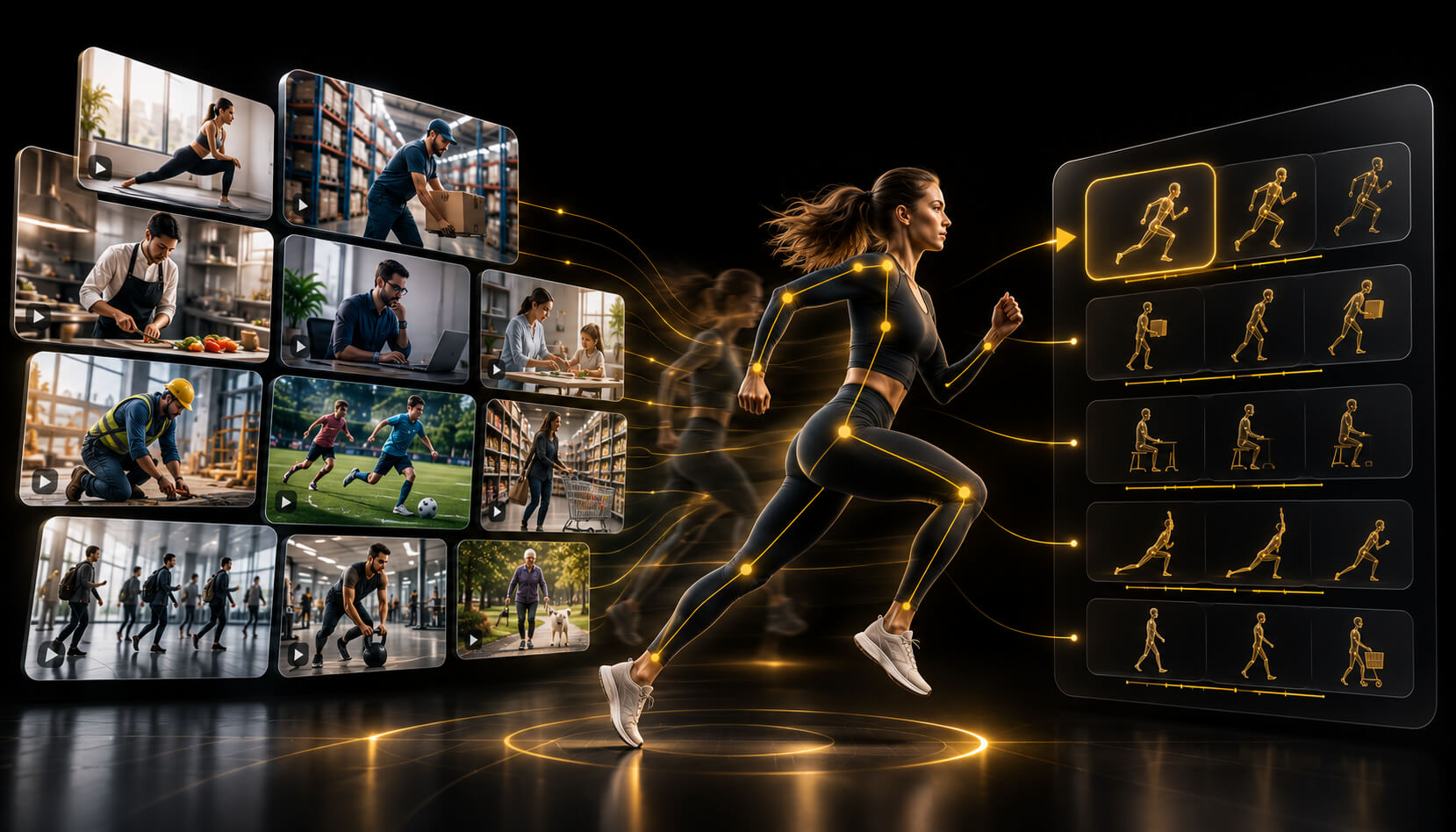
Activities and Environments
Coverage is assessed against your required actions and sequence depth. Specialized procedures and controlled scripts may require custom production.
Household Activities
Explore Egocentric Household Activities and Long-Form Procedural Video for routines. Everyday Moments Images adds frame-level views of daily activities.
Workplace Tasks
Computer use, meetings, manual work, equipment handling and collaboration in professional settings. Specify participant roles and the task stages that need to remain visible.
Sports and Exercise
Sports DV06 covers padel, MMA, kickboxing, cricket and volleyball. The Sports Video Dataset adds exercise and fitness footage for a broader range of movements.
Product and Device Use
People using phones, computers, appliances and tools, with the action stage and outcome visible where required. Define which participant-object interactions each sequence must cover.
Retail and Shopping
Browsing, product selection, item comparison, cart or basket use, queueing, payment and staff-customer interaction. Specify the participant roles and store contexts needed for each action.
Mobility and Social Activities
Urban Life and Mobility Video covers commuting, navigation, phone use and social interaction. Milestone Celebrations Images adds frame-level group events and expressive contexts.
Video Sequences and Frame-Level Data
Use video datasets for action progression and image datasets for frame-level tasks. Diverse People Images provides participant variation; Candid Family and Lifestyle Images covers family routines, conversation and leisure.
Define Your Activity Dataset
Sequence and Execution
Preparation, execution and completion; duration, speed, repetitions, transitions and execution style. Define whether actions must remain uninterrupted from start to finish.
Participants and Interactions
Participant counts and roles, single- or multi-person actions and object relationships. Specify required variation in appearance and wardrobe, and who performs each action.
Viewpoints and Environments
Camera angle, distance, framing and movement; indoor or outdoor settings, lighting, clutter and occlusion. Specify relevant object-state changes and visibility requirements.
Labels and Technical Fields
Hierarchical action classes, multi-label rules, scene descriptions and captions; duration, frame rate and resolution. Agree annotation instructions and quality acceptance criteria.
Existing Footage, Archive Curation or Custom Capture
Review Human Motion DV01 for current coverage, specifications and samples. We can also curate an archive subset or combine it with custom activity capture to address missing actions, viewpoints or class quotas.
Wavebreak Media has managed professional image and video production since 2005. Capture feasibility, annotation scope and release requirements are agreed before new production.
Frequently Asked Questions (FAQ)
Existing assets may include descriptions and technical metadata. Action labels, timestamps and temporal segments are confirmed or commissioned per project. Do not assume every collection includes task-specific ground truth.
Boxes, tracks, keypoints, participant roles and action-object relationships can be scoped separately. Video does not itself include motion-capture measurements or 3D pose ground truth; the required method, output and feasibility must be confirmed.
Where source footage supports the required sequence. Review samples for missing stages or cuts; new filming may be needed for complete procedures. Extracted frames can retain source IDs and timestamps, but do not replace temporal footage for tasks that depend on action progression.
Define actor-, shoot-, location- and sequence-aware grouping, with rules for near-duplicates and adjacent frames. Actor-separated splits depend on reliable participant identification. Confirm which relationships can be verified in archive footage before setting the split protocol.
Agree media formats, asset and sequence IDs, metadata, versioned splits and manifests. Checksums can be included where required. See dataset delivery and security for transfer requirements.
Available provenance and applicable releases are reviewed for the selected assets and intended AI use. Permitted uses and restrictions are defined in the agreement. See dataset licensing and compliance.
Request a Human Activity Recognition Dataset
Send your target actions, model task, sequence requirements, approximate volume and annotation needs. Include a sample or capture brief if available.
