
AI Model Evaluation and Benchmark Datasets
License visual and multimodal data from Wavebreak Media's owned archive, or commission custom capture for model evaluation. We produce the source media and can prepare test sets with the references needed to compare model performance under your target conditions.
Featured Datasets
Explore sample licensed datasets across image, video, audio, and text collections.


AI Model Evaluation Datasets by Task
Wavebreak Media supplies visual and multimodal test data and agreed references. Your team runs the models and calculates results using its evaluation protocol.
Classification and Recognition
Target classes, neighboring classes and hard negatives with class or instance labels. Use these references for accuracy, precision, recall, F1, confusion matrices and results by test slice.
Detection and Segmentation
Computer vision data with commissioned boxes or masks and defined annotation rules. Use matching references for mAP, IoU, localization errors and results by class or capture condition.
Activity and Temporal Evaluation
Human activity data with labels, timestamps and sequence boundaries for complete actions and transitions. Evaluate classification, timing errors and consistency across test slices.
Vision-Language and Retrieval
Vision-language data with pairs, queries, candidates and negatives. Pair IDs, captions and relevance judgments support Recall@K and ranking analysis under an agreed protocol.
Captioning and Generative Models
Generative AI data with visual inputs, prompts and comparison sets. References, ratings, rubrics and failure categories support consistency, preference and error-frequency analysis.
Regression and Model Comparison
A frozen test set with stable references, slices and scoring rules. Compare model versions, prompts, thresholds, preprocessing or vendors to identify regressions and performance trade-offs.
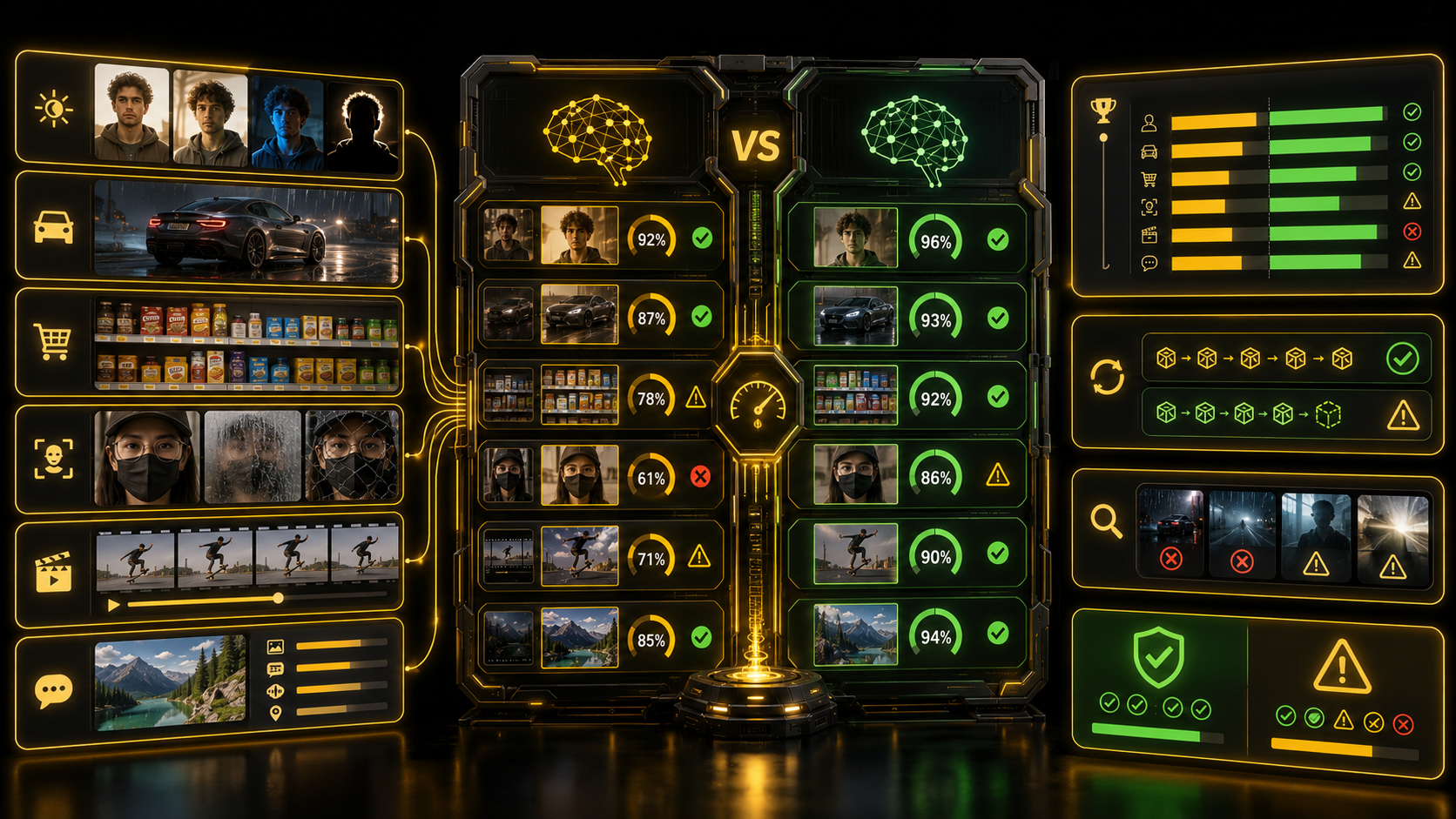
Test Slices for Robustness and Failure Analysis
Test slices isolate specific classes or conditions so an aggregate score does not hide failures. Select those that matter to the intended deployment.
Class Coverage
Target and neighboring classes, uncommon instances, background examples and hard negatives. Diverse Facial Images provides source material for face-centered test slices.
People and Representation
Documented variation in appearance, clothing, activity and context, without inferring sensitive attributes. Diverse People Images provides broader human-centered source material.
Environment and Context
Homes, workplaces, retail, healthcare, fitness and streets, with indoor and outdoor conditions. Specify relevant geography, weather and background complexity for the intended deployment.
Capture and Format
Lighting, viewpoint, resolution, compression and aspect ratio. Review horizontal HD video and vertical video for format-based slices; confirm specifications and eligibility before selection.
Motion and Timing
Action speed, sequence length, transitions, occlusion and interaction. Review Human Motion DV01 for movement coverage and Synchronized Multi-View Video for cross-view tests.
Edge Cases and Shifts
Rare scenarios, ambiguity, partial subjects, crowded scenes, unusual viewpoints and unseen formats. Define which known failures or deployment changes each test slice is intended to examine.
Holdout Sets, Data Leakage, and Benchmark Versioning
Separation checks require information about the data used for training and model selection. Eligibility as held-out data must be assessed; archive ownership alone does not establish it.
Training-Data Exclusions
Use disclosed inventories, asset IDs, URLs, fingerprints or hashes to identify known training and validation assets that must be excluded from the test set.
Duplicate Checks
Compare exact and near duplicates against disclosed data using the agreed method. Record comparison coverage, unresolved matches and the limits of the checks.
Source-Aware Grouping
Keep related frames, clips, scenes, participants, locations or shoots together where the protocol requires it. Confirm which source relationships can be verified.
Benchmark Versioning
Freeze the approved files, references, slice definitions and evaluation protocol under a versioned manifest. Record changes before creating a new benchmark version.
Archive-Curated and Custom Evaluation Sets
Select eligible assets from the dataset library or commission custom evaluation production for missing scenarios, viewpoints, repetitions and hard negatives. A hybrid set combines archive coverage with controlled new capture.
Wavebreak Media has managed professional visual production since 2005. Review candidate samples and capture feasibility before committing to a full test set.
Evaluation Dataset Specification and Package
Define the decision the evaluation must support, then agree the following specification and deliverables.
Evaluation Unit
Define the image, frame, clip, sequence, visual-text pair, query-candidate set, prompt, output or grouped scenario on which the model will be evaluated.
Coverage and Sample Plan
Set operating conditions, class balance, slice quotas and volume around the evaluation decision. Include statistical confidence requirements in the sample plan.
Reference Data
Specify labels, boxes, polygons, masks, timestamps, captions, judgments, expected outputs or review rubrics, matched to the selected metrics and thresholds.
Dataset Documentation
Include asset IDs, splits, slices, pairings, exclusions, taxonomy and schema. Record QA status, known limitations and a change log for the delivered version.
Licensing and Provenance
Review permitted uses, available provenance, applicable releases and rights documentation. Confirm the agreed scope for the selected evaluation data.
Formats and Delivery
Agree media formats, manifests, integrity records and secure transfer requirements. Specify the technical package your evaluation system needs to ingest.
AI Model Evaluation Dataset FAQs
Validation data guides model development; a held-out test set supports evaluation after those choices. A benchmark also defines a repeatable task, protocol and scoring method. Training data is used to fit the model.
No. Existing media and metadata must be reviewed against the evaluation task. Labels, masks, judgments, ratings or other references may need separate preparation, with agreed annotation instructions and acceptance criteria.
Not for undisclosed training data. Checks can assess overlap against information you provide, but cannot establish absence from unknown training corpora. Agree the scope of checks and record unresolved overlap risks.
A project can specify restricted access to reference labels or private subsets. Agree who can access inputs, labels and results, along with transfer rules and permitted uses, before delivery.
Review it when repeated model development, new failure cases, deployment changes or data drift reduce its relevance. Keep the original baseline version and document additions so results from different versions are not treated as directly equivalent.
No. Subgroup slices can reveal performance differences but do not certify a model. Conclusions depend on the protocol, metrics, sample design and broader review. Use documented, appropriately authorized subgroup data; do not infer sensitive attributes from appearance.
Request an AI Model Evaluation Dataset
Send your model task, target test slices, reference requirements and approximate volume. Include available training-data exclusions and your delivery timeline.
