
Facial Expression and Emotion Recognition Datasets for AI Training
License facial expression images and video from Wavebreak Media's owned archive, or commission capture of specific expressions and facial movements. We produce the source media and can scope labels, action units and temporal annotations for your model.
Featured Datasets
Explore sample licensed datasets across image, video, audio, and text collections.


Facial Expression Data by Task
Configure facial expression recognition (FER) data around visible facial movements and your annotation framework. For broader visual tasks, see computer vision datasets.
Expression Classification
Face-centered images or clips grouped by observable expression classes, with neutral examples and inclusion rules for visually similar or mixed expressions.
Facial Action Unit Analysis
Images or sequences for Facial Action Coding System (FACS) analysis, with commissioned labels for action-unit presence, combinations and intensity.
Expression Intensity
Visible expression strength represented on an agreed ordinal or continuous scale, with examples spanning the levels and boundaries your model must distinguish.
Temporal Expression Dynamics
Video showing expression onset, development, peak, transition and offset, with commissioned timestamps, temporal boundaries or frame-level labels.
Cross-Condition Robustness
Consistently labeled examples across participants, viewpoints, lighting and visibility conditions to test generalization under deployment-relevant changes.
Evaluation and Class Expansion
Underrepresented classes, neutral examples and hard negatives for model evaluation, using held-out data and agreed reference criteria.
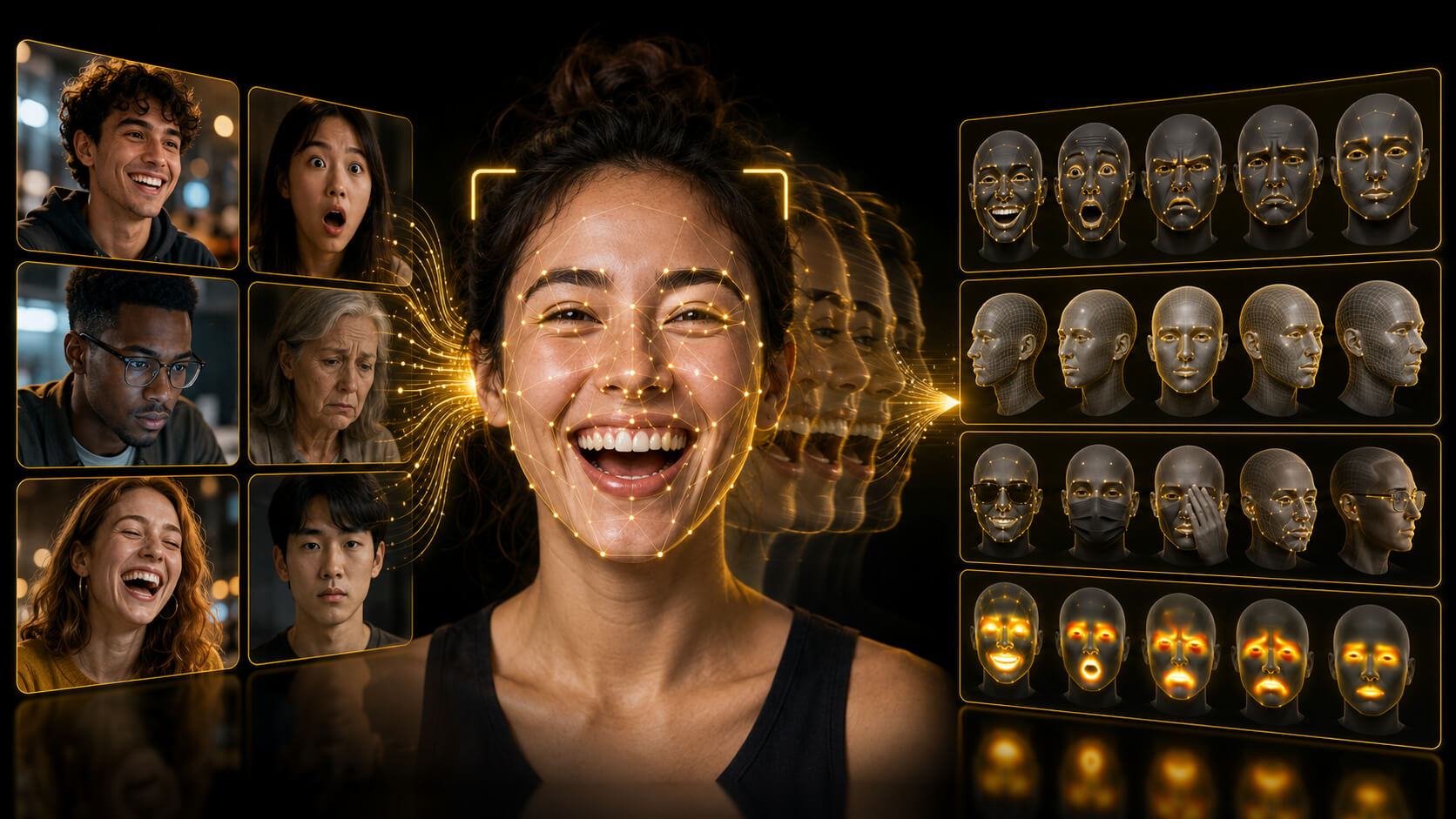
Expression and Capture Coverage
Availability is assessed against the required expressions, participants and sequence depth. Controlled action-unit, intensity or temporal coverage may require new capture.
Still Images and Face Crops
Portraits, contextual images and derived crops selected by resolution, framing and visibility. Face-Focused Portrait Images provides face-centered source material.
Video and Frame Sequences
Clips and ordered frames with source links preserved. Celebrations Video provides family and social contexts; face selection and expression labels are scoped separately.
Category and Intensity Coverage
Neutral, low-intensity, mixed-cue and visually adjacent examples across the agreed taxonomy. Define class quotas and difficult label boundaries to guide selection and annotation.
Head Pose and Viewpoint
Frontal, profile, angled, raised, lowered and moving head positions. Specify camera distance, orientation and framing, including changes within the required expression sequence.
Visibility and Occlusion
Full or partial face visibility with glasses, hair, hands, objects and crop boundaries. Define acceptable motion blur, pose changes and other occlusions for the intended model task.
Participants and Settings
Participant, wardrobe, background and lighting variation for the target use. Diverse Facial Images provides source material for face-focused training and evaluation.
Labels, Metadata and Quality Controls
Record and Label Structure
Stable asset, subject, clip and frame IDs, linked to the agreed expression taxonomy, action-unit schema and intensity scale. Define neutral, negative and multi-label rules.
Face and Capture Metadata
Face boxes, landmarks, head pose, visibility, occlusion and lighting, plus resolution, frame rate and camera movement. Availability and preparation are confirmed per project.
Annotation Quality
Written labeling guidelines, reviewer agreement, disagreement handling and acceptance thresholds. Define how ambiguous cues and uncertain labels should be recorded and reviewed.
Packaging and Delivery
Source-linked records, split manifests and agreed media formats, with checksums where required. Specify technical documentation and secure dataset delivery before preparation.
Existing Collections and Custom Expression Data
Review existing image and video collections or curate a subset by expression, pose, participant and setting. Assess candidate samples before commissioning additional labels.
Wavebreak Media has produced professional visual media since 2005. Custom capture and annotation can address missing classes, action units, intensity levels or sequences, with feasibility and acceptance criteria agreed before production.
Frequently Asked Questions (FAQ)
Not always. Descriptions and technical metadata are not equivalent to task-specific ground truth. Review a sample to confirm which labels already exist and which need new annotation.
FACS annotation can be scoped after reviewing the required action units, source visibility and qualified annotator availability. Confirm feasibility on representative material before commissioning the full labeling project.
No. Expression recognition analyzes visible facial movements or categories; face recognition identifies or verifies a person. This page does not describe identity-recognition datasets.
Where participant identities are available or controlled during capture. Agree subject-, shoot- and sequence-aware grouping, including adjacent frames and near-duplicates. Unknown participant relationships can limit separation checks.
Licensing is finalized for selected files and intended AI use. Available provenance, applicable releases, and dataset licensing and compliance requirements can be reviewed before approval; permitted uses are defined in the agreement.
No. Observable facial movements do not establish a person's internal emotional state. Emotion-category labels should be understood as labels under a specified annotation framework, not verified psychological states.
Request a Facial Expression Dataset
Send your target expressions or action units, image or video requirements, approximate volume and annotation needs. Include a label schema or example sequence if available.
